Support falls, but parliament backs the monarchy
The distinction between support for the royal family and support for the institution is visible in Norway's opinion polls. A Norstat survey for NRK published in February 2026 recorded 60% support for retaining the monarchy, the lowest figure the polling firm had measured. Support for abolition increased from 19% in January to 27% by mid-February.
Asked how well individual royals represented the family, respondents in the same survey gave King Harald 9.2 out of 10. Queen Sonja received 8.6, Crown Prince Haakon 7.9 and Crown Princess Mette-Marit 3.7.
A separate Verdens Gang/InFact poll released on February 3 found 61% favored keeping the monarchy, compared with 72% a year earlier, while 27% backed a republic. On Mette-Marit's future role, 44% said she should not become Norway's next queen and 33% said she should, Reuters reported.
Parliament's support was more decisive. On February 3, 2026, the Storting rejected a proposal to replace the monarchy with a republic by 141 votes to 26, retaining King Harald and his descendants as heads of state. Similar proposals come before lawmakers every few years and have consistently lost by wide margins. Constitutional change requires a two-thirds majority across two parliamentary terms.
The criminal case and the crown princess
The most damaging recent case concerns Marius Borg Høiby, Mette-Marit's son from an earlier relationship. Although he grew up alongside the royal family and frequently appeared with them, he has no royal title and does not belong to the Royal House.
On June 15, 2026, Oslo District Court convicted Høiby on 34 of 40 charges and imposed a four-year prison sentence. The convictions covered two counts of rape, abuse in close relationships, assault, possession and supply of drugs, and violations of restraining orders. The court acquitted him on two other rape counts.
Prosecutors had requested seven years and seven months in prison; his defense lawyers argued for no more than 18 months. He was also ordered to pay four women a combined 640,000 Norwegian kroner, about £50,000 or US$61,000, in compensation. Among them was his former girlfriend, Norwegian influencer Nora Haukland.
Høiby's lawyer said he would appeal. The royal household declined to comment on the outcome, saying the courts had considered the case.
Mette-Marit separately apologized for her past contact with the late American financier Jeffrey Epstein after documents detailing that contact became public. The controversies have damaged the family's popularity and prompted wider debate about the monarchy, though most surveys have continued to show a majority in favor of keeping it.
A head of state without political decision-making power
Norway's system separates the monarch's formal responsibilities from the political decisions made by elected leaders. The constitution, signed at Eidsvoll on May 17, 1814, establishes a constitutional monarchy and remains one of the oldest written constitutions in use. Political authority rests with the government and the Storting.
The king formally appoints the government and opens each autumn's parliamentary session. He also chairs the Council of State, normally held at the palace on Fridays, where formal decisions receive his signature. Those decisions reflect choices made by elected politicians, not independent political judgments by the monarch.
The present monarchy traces its origins to the end of Norway's union with Sweden in 1905. Before accepting an invitation to take the throne, Denmark's Prince Carl requested a referendum. Voters clearly supported the monarchy, and he became Haakon VII. That public endorsement remains an important part of the institution's claim to democratic legitimacy.
Health and succession
Harald V, who was born in 1937 and became king in 1991, is among the world's oldest reigning monarchs. His birth was also the first of a Norwegian prince in Norway for more than 500 years. Health problems have reduced his public schedule, leaving Crown Prince Haakon to assume more responsibilities.
During a private visit to Malaysia in 2024, Harald became seriously ill and was brought home aboard a chartered SAS aircraft used as an air ambulance, according to Norway's News in English.
His marriage helped shape the family's public story. Harald refused to marry anyone other than Sonja Haraldsen, the daughter of an Oslo shopkeeper. After years in which their relationship remained private, his father, King Olav V, approved the marriage, and the couple wed in 1968. Sonja developed her own following through her interests in art and mountain hiking.
Harald's speeches have also contributed to his popularity. A 2016 address describing Norwegians of different backgrounds, religions and sexual orientations drew worldwide attention.
Haakon likewise married outside royal circles when he wed Mette-Marit Tjessem Høiby in 2001. Initial controversy over the marriage gave way to broad respect for her work involving mental health, literature and social inclusion. Her chronic lung disease has sometimes restricted her duties. According to the palace, as reported by the BBC, she is seriously ill with a form of pulmonary fibrosis and had been placed on a lung transplant waiting list by June 2026.
Their daughter, Princess Ingrid Alexandra, was born in 2004 and is second in the line of succession. She has completed military service and studied abroad, and is set to become Norway's first reigning queen since the Middle Ages. Her younger brother, Prince Sverre Magnus, born in 2005, leads a less public life.
Harald's daughter, Princess Märtha Louise, stepped away from official royal duties in 2022. She married American Durek Verrett in 2024, and her alternative spiritual business has generated sustained media debate.
Public duties and royal homes
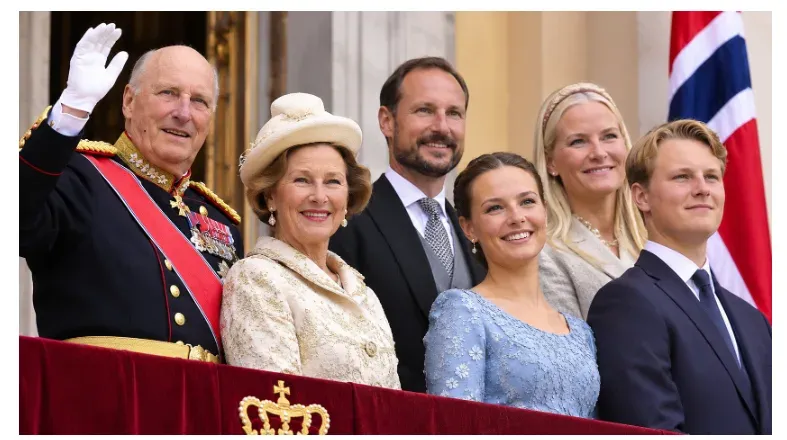
Norwegians encounter the monarchy through a calendar of familiar public events. On May 17, the royal family greets the children's parade from the Oslo palace balcony. The king delivers the throne speech when parliament opens in the fall and addresses the country again on December 31, when a large share of the population watches his New Year's speech. Official travel takes the royals around Norway and overseas, and they often attend Oslo's Holmenkollen ski festival in March.
The Royal Palace, completed in 1849 at the top of Karl Johans gate in Oslo, serves as the king's official residence. Visitors can enter its park, tour the principal rooms during summer and watch the daily changing of the guard at 1:30 p.m.
Haakon's family lives at Skaugum in Asker, outside Oslo, an estate long associated with the heir to the throne. Other royal properties include Bygdøy Kongsgård, a farm on the Bygdøy peninsula, and Oscarshall, a small palace overlooking the Oslofjord that welcomes summer visitors.
The family also uses Stiftsgården in Trondheim, one of Scandinavia's largest wooden buildings, and Gamlehaugen, a lakeside villa in Bergen. The royal yacht K/S Norge carries the family on official visits along the Norwegian coast and abroad. Many royal properties belong to the state rather than to the family privately, with upkeep paid through the state budget.
Expectations of the next generation
Haakon and, eventually, Ingrid Alexandra will inherit the task of maintaining public confidence. Both have reputations for taking their responsibilities seriously and working hard. They also face the challenge of rebuilding trust and connecting with younger Norwegians, who are less attached to tradition than older generations.
Accessibility has long been central to the family's standing. One enduring example dates to the 1973 oil crisis, when King Olav V took a tram to go skiing and paid his fare alongside other passengers. The episode remains a reference point for the modest, approachable conduct Norwegians expect from their royals.