Children among casualties near the capital
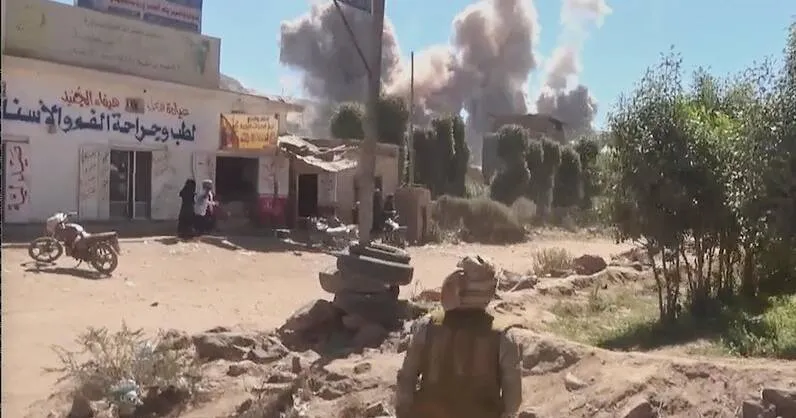
Anees Alasbahi, spokesman for the Houthi-run health ministry, blamed Saudi Arabia for the attack on al-Shariya, a farming village about 15 kilometers northeast of Sanaa. He said people remained trapped beneath destroyed homes and accused Saudi forces of launching further strikes at emergency workers rescuing survivors.
Saudi Arabia's Center for International Communication said it was investigating the report. Reuters could not independently verify the Houthi account.
The Houthi-run broadcaster al-Masirah had earlier reported that Saudi aircraft bombed homes in the militia-controlled Bani Hushaysh district. Its hospital footage showed staff lifting the limp bodies of young children from ambulances, while other children received care on stretchers, bloodied and bandaged.
Images from the village showed demolished houses and clouds of dust as residents sheltered in agricultural fields. Saba, the Houthi-controlled news agency, also reported further Saudi attacks on homes and paramedics there, without providing a casualty estimate for those strikes.
Market deaths and attacks on Saudi facilities
The village strikes followed another reported mass-casualty attack a day earlier. Houthi officials said strikes on a market in southern Yemen killed 30 people; the Houthis and Yemen's Saudi-backed military blamed each other.
Saudi Arabia supports Yemen's internationally recognized government. In the southwestern province of Taiz, pro-government media said government troops had fought off a Houthi assault on the al-Aqroud front. Those reports described hours of combat and heavy Houthi losses.
The Houthis, meanwhile, said they had conducted six operations involving large numbers of ballistic missiles, cruise missiles and drones, with some directed at facilities in neighboring Saudi Arabia. Their military spokesman, Yahya Saree, identified King Khalid airport, oil storage tanks and an Aramco distillation tower in Riyadh as targets of the first operation.
Saree said a second operation targeted Aramco's facility in Khurais, in Saudi Arabia's Eastern Province, and a third targeted a pumping station near Dawadmi, west of Riyadh. Airports and oil infrastructure have been prominent targets as Houthi attacks on the kingdom have increased in recent months.
In a November 5 assessment, the Institute for the Study of War and the Critical Threats Project said Russia was supplying the Houthis with targeting intelligence for strikes on Saudi Arabia. The groups said those attacks were intended to limit Saudi oil exports and keep oil prices high.
From the 2022 truce to renewed war
The fighting that resumed in July 2026 broke a UN-brokered truce reached in 2022. That agreement had largely stopped attacks between the Saudi-led coalition and the Houthis, who control Sanaa. The House of Commons Library says the main frontlines between Houthi and government forces had also remained largely frozen since the ceasefire.
The Sana'a Center for Strategic Studies traces the escalation to July 13, when a runway strike prevented a civilian Mahan Airlines aircraft from landing in Sanaa. The Iranian carrier, which is under US sanctions, was bringing a Houthi delegation back from the funeral of Iranian Supreme Leader Ayatollah Ali Khamenei. The aircraft diverted to Hodeidah.
The Houthis responded with missile attacks on Saudi Arabia's Abha airport and announced a blockade of Saudi shipping.
During the first week of September, a rapid Houthi offensive down Yemen's Red Sea coast captured the port city of Al-Makha and Mayyun, also known as Perim Island, at the Bab al-Mandeb strait. The House of Commons Library says control of the strait, through which about 7% of global oil passes, is now disputed. UNOCHA reported that at least 213,000 people had been displaced since the September offensive began.
On October 4, Presidential Leadership Council President Rashad al-Alimi announced "Operation Dawn of Yemen," an effort to recapture Houthi-held areas, including Sanaa. The Saudi-led coalition said it involved 100 fighter jets, acknowledging for the first time since 2022 that it had resumed air attacks against the Houthis.
Five days later, UN special envoy for Yemen Hans Grundberg told the Security Council that the country had returned to "full-scale war". The council condemned the escalating Houthi attacks on Saudi Arabia, including attacks affecting civilian aviation and energy infrastructure.
Foreign support and rejected ceasefire offers
Saudi Arabia signed the Mecca Agreement, a mutual defensive alliance with Turkey and Pakistan, on August 7. Turkey has offered defensive and technical assistance but ruled out sending troops for offensive operations. Its parliament has not yet ratified the agreement.
The UK announced defensive support for Saudi Arabia in September, providing an RAF Voyager aerial refueling aircraft. RAF Typhoon fighters began defensive counter-air missions over the kingdom in October. The UK said its aircraft would not join offensive operations against the Houthis.
Diplomatic efforts have also failed to secure a ceasefire. Sources briefed on Saudi-Houthi negotiations told The Wall Street Journal on November 4 that the Houthis had demanded Saudi recognition of their sovereignty over all of Yemen as a condition for ending the war. According to the account, relayed in the Institute for the Study of War and Critical Threats Project's November 5 update, the demand came shortly after the September 9-10 Houthi assault on the Red Sea coast.
The Houthis have rejected several Saudi ceasefire proposals, including one that reportedly offered $1 billion in reparations.